Mastering the Staff, One String at a Time
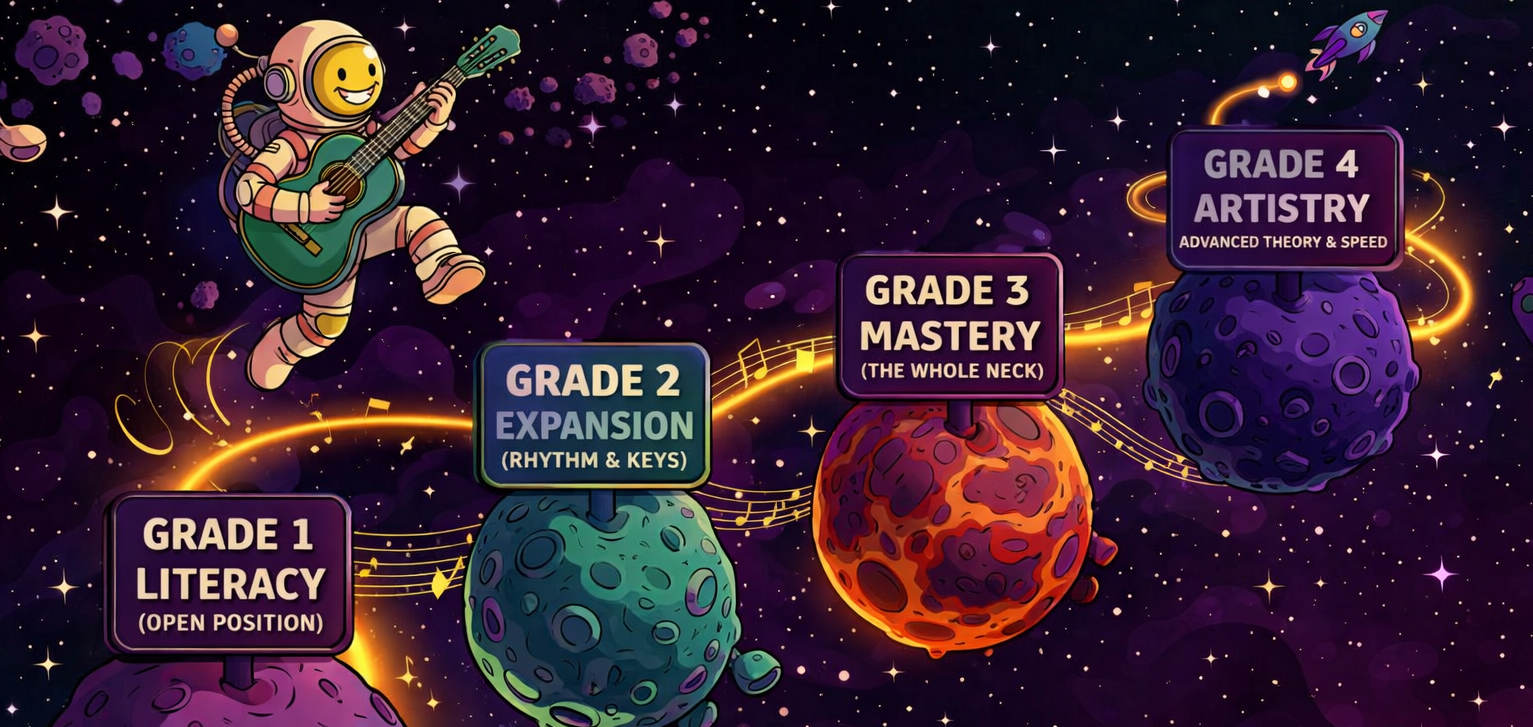
The primary objective of Grade 1 is not just to teach finger placements; it is to build comprehensive music literacy. We start at the absolute beginning, forging a direct connection between the written notes on the page and the precise fret on the guitar.
Your student’s journey doesn’t jump straight into multi-string patterns; we introduce the fretboard systematically, dedicating entire missions to mastering one string at a time. We begin at the very top with the 1st String (High E). After sight-reading melodies and achieving perfect notation recognition on that single string, we proceed to the 2nd String (B). Only when both are mastered, forming a solid two-string vocabulary, do we move to the remaining four. This methodological progression removes the overwhelmed “search and destroy” method commonly found in other online tutorials. Every natural note is identified, played, and understood within its primary harmonic function.
By the time your student completes Grade 1, they won’t just be memorizing patterns; they will be able to pick up any piece of music in the Open Position and accurately read both the pitches and the specific rhythms required. This grade delivers a complete, standardized music education that parents can trust and state homeschool portfolios require.
From Notes to Fluency
Once your student has learned the “musical alphabet” in Grade 1, Grade 2 is where they start “reading sentences” and speaking the language of music fluently. This is the grade that transitions them from just hitting the right notes to grooving. The primary engine powering this mission is Rhythmic Expansion.We don’t just briefly cover rhythmic subdivisions; Grade 2 dives deep into the complex time signatures that give music its pulse. Your student will master the Eighth Note and the Dotted Note, essential components of virtually all popular and classical genres.
We don’t just explain them; we dedicate entire etudes to feeling the difference between the “down-beat” and the crucial “up-beat,” teaching them how to execute technical syncopation with precision. This grade also introduces the complex, dancing feel of 6/8 Compound Time. This isn’t just about counting to six; it’s about understanding the internal triplets that make a song flow, preventing their playing from sounding mechanical.
Furthermore, Grade 2 provides the systematic training required to move beyond the simple C Major system. We introduce Sharps ($\sharp$) and Flats ($\flat$)—the “black keys” of the guitar—one at a time, across all learned strings. This methodical approach ensures your student understands why an F# exists and where it lives on the neck. They will learn to read and play in the foundational key signatures used by songwriters, specifically the Key of G Major (introducing F#) and the Key of D Major (introducing C# and F#). Upon completing this grade, your student is no longer a beginner; they are a literate, rhythmic musician ready to interpret complex sheet music in multiple keys.
Beyond the Open Strings
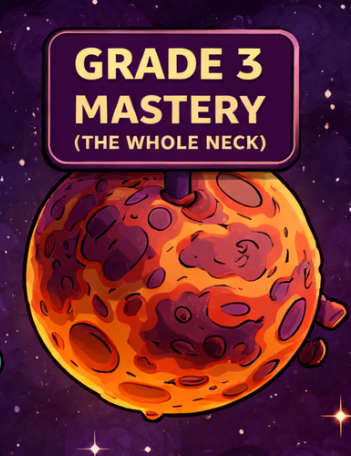
In Grade 3, your student leaves the safety of the “Open Position” and begins to navigate the entire length of the guitar neck. This is a pivotal academic transition where the guitar stops feeling like a collection of separate frets and starts functioning as a single, logical system. We achieve this by systematically teaching Position Playing, moving the student’s hand to the 3rd, 5th, and 7th positions. This isn’t just about playing higher notes; it’s about learning to play the same melodies in different locations on the neck to achieve different tonal “colors”—a skill essential for any advanced musician.
The core of this grade is the introduction of the Moveable Barre Chord. This is the “Eureka” moment in a guitarist’s education. Instead of learning dozens of individual chord shapes, your student learns a few master “power shapes” that can be moved up and down the fretboard to play any chord in existence. We bridge the gap between simple chords and professional harmony by introducing Minor 7th and Dominant 7th systems. Your student will learn to read and execute these complex shapes across all six strings, giving them the tools to play everything from classical etudes to sophisticated jazz and pop arrangements.
Rhythmically, Grade 3 introduces the high-speed precision of Sixteenth Notes. We focus on “technical endurance,” ensuring your student can maintain a perfect internal pulse even during rapid-fire passages. We also explore the emotional depth of Minor Key Architecture, covering the Natural, Harmonic, and Melodic minor scales. By the end of Grade 3, your student has achieved “Fretboard Independence.” They can pick up a piece of music, identify the best position on the neck to play it, and execute it with the rhythmic discipline of a seasoned performer. This grade represents a high-school level of music proficiency that serves as a powerful centerpiece for any academic portfolio.
Technical Virtuosity and Advanced Music Theory
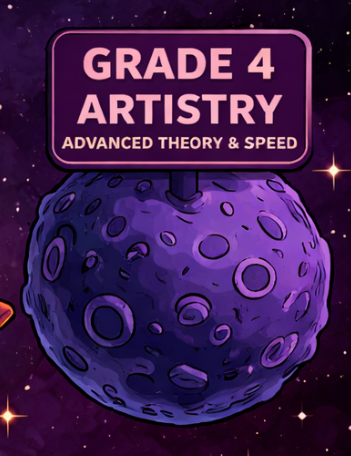
Grade 4 represents the “Senior Capstone” of the Strumium journey. This is where the student graduates from a proficient player to a true technician of the instrument. In this final grade, we move beyond the mechanics of “how” to play and focus on the artistry of High-Level Performance. We do this by exploring the most complex regions of the guitar neck—the 7th through 12th positions—ensuring that no fret is “off-limits.” Your student will master total neck independence, learning to execute three-octave scales with seamless positional shifts that maintain a consistent, professional tone across every string.
The academic rigor of Grade 4 is designed to match collegiate-level foundational requirements. We dive deep into Advanced Harmonic Analysis, moving past basic chords to master 9th, 11th, and 13th “extended” harmonies. Your student will learn the science of Modulation, understanding how a composer pivots from one key to another and how to navigate those transitions fluently on the fretboard. Rhythmically, we tackle the most challenging meters in Western music, including complex compound times and polyrhythmic “two-against-three” patterns. This level of rhythmic discipline is what separates a student from a virtuoso.
The mission culminates in the Capstone Repertoire, featuring advanced etudes from the Mel Bay Grade 4 canon and classical masterpieces by Bach and Giuliani. To graduate, the student must demonstrate not just speed, but Dynamic Artistry—the ability to control volume, articulation, and phrasing to breathe life into the music. By the end of Grade 4, your student has achieved a level of “Supernova” mastery that is fully prepared for university music auditions or professional-tier performance. They leave Strumium with a comprehensive, permanent record of musical achievement that serves as a testament to years of dedicated academic discipline.